Market Overview
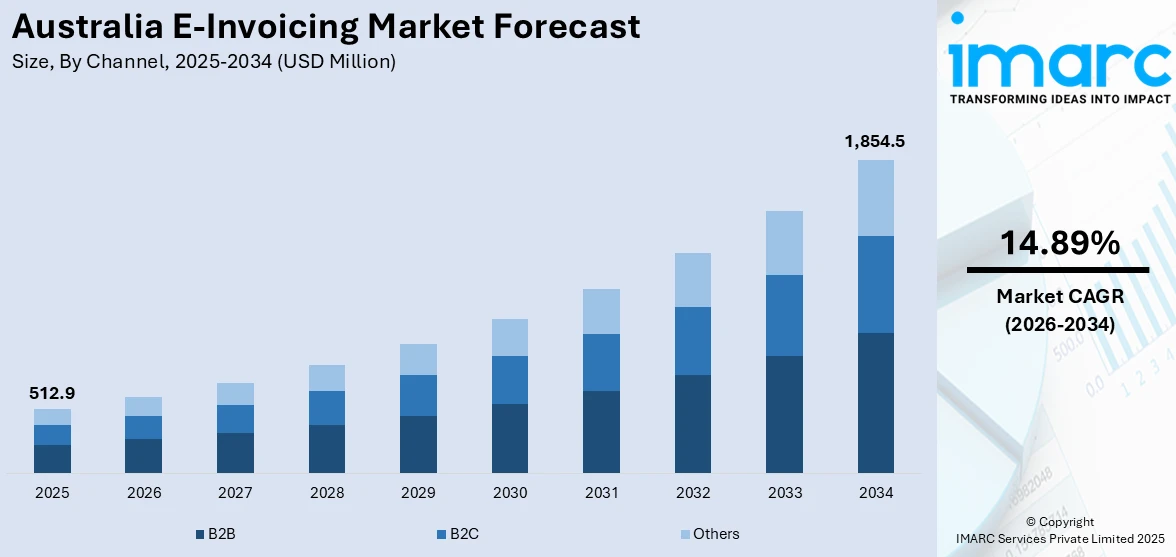
The Australia e?invoicing market is witnessing strong growth driven by government mandates for digital invoicing adoption, increasing demand for automation in financial processes, and rising awareness of cost savings and operational efficiency. The market size reached USD 512.9 Million in 2025 and is projected to reach USD 1,854.5 Million by 2034, exhibiting a compound annual growth rate (CAGR) of 14.89% during 2026?2034.
This market is strategically important to Australia's digital finance and business operations economy, supporting streamlined payment cycles, reduced manual data entry errors, and enhanced cash flow management across businesses of all sizes. The Australian Government’s push for e?invoicing adoption through the Peppol framework is accelerating the shift toward fully digital accounts payable and receivable systems. The market’s rapid growth reflects the increasing recognition of e?invoicing as a foundational element of modern business operations.
The Australia e?invoicing market is poised for sustained expansion, driven by government mandates, supply chain digitisation, and enterprise software integration. With a projected CAGR of 14.89% through 2034, the market presents significant opportunities for solution providers focusing on interoperability, cloud?based platforms, and value?added financial services.
AUSTRALIA E-INVOICING MARKET SUMMARY
The Australia e?invoicing market encompasses digital invoicing solutions that enable businesses to send, receive, and process invoices electronically through structured data formats, eliminating manual data entry and paper?based processes.
The ecosystem spans e?invoicing service providers, enterprise resource planning (ERP) vendors, accounting software companies, government agencies, and businesses of all sizes across industries.
Major segments identified in the e?invoicing industry include deployment (cloud, on?premises), application (B2B, B2G, B2C), end user (large enterprises, small and medium enterprises), and region (Australia Capital Territory & New South Wales, Victoria & Tasmania, Queensland, Northern Territory & Southern Australia, Western Australia).
Key trends shaping the market include the increasing adoption of the Peppol framework for interoperability, integration with cloud accounting software, and the rise of value?added services such as early payment options and automated reconciliation.
PORTER'S FIVE FORCES ANALYSIS – AUSTRALIA E-INVOICING MARKET
The competitive dynamics of the Australia e?invoicing market can be analysed using Porter's Five Forces framework.
Bargaining Power of Suppliers – Moderate
E?invoicing solution providers rely on software developers, cloud infrastructure providers, and interoperability framework partners. The increasing adoption of the Peppol standard has created a network effect, giving established service providers moderate leverage. However, the availability of multiple software vendors and open?source options helps balance supplier influence.
Bargaining Power of Buyers – Moderate to High
Australian businesses benefit from a wide range of e?invoicing solutions across cloud and on?premises deployments, with the ability to integrate with existing accounting and ERP systems. Government mandates have created baseline demand, but businesses can choose among multiple service providers, strengthening their negotiating position.
Threat of New Entrants – Moderate
Significant capital requirements for software development, Peppol certification, and customer acquisition create barriers for traditional entrants. However, the growing demand for niche solutions in specific industries has enabled cloud?focused startups to access the market with differentiated offerings.
Threat of Substitutes – Low
Traditional paper invoicing and PDF?based electronic invoicing represent partial substitutes, but they lack the structured data format and automation benefits of true e?invoicing. The Australian Government’s push for e?invoicing adoption through the Peppol framework reduces substitution risk.
Competitive Rivalry – High (Healthy)
The market features intensifying competition among e?invoicing service providers, ERP vendors, and accounting software companies. Competition is driven by interoperability, ease of integration, pricing models, and value?added services rather than purely price?based rivalry.
Request for Sample Report: https://www.imarcgroup.com/australia-e-invoicing-market/requestsample
MARKET GROWTH DRIVERS
Government Mandates and Peppol Framework Adoption
The Australian Government has been a key driver of e?invoicing adoption, mandating its use for supplier invoices to government agencies. The adoption of the Peppol interoperability framework has enabled seamless e?invoicing exchange across different software platforms and service providers. Government initiatives to promote e?invoicing as part of the broader digital economy strategy have created baseline demand, encouraging businesses of all sizes to adopt digital invoicing solutions. The public sector’s leadership in e?invoicing adoption is setting an example for private sector businesses to follow.
Demand for Automation in Financial Processes
Businesses across Australia are increasingly seeking ways to automate financial processes to reduce costs, minimise errors, and improve cash flow management. E?invoicing eliminates manual data entry, reduces invoice processing times from days to hours, and enables straight?through processing of accounts payable. The integration of e?invoicing with cloud accounting software and ERP systems enables real?time visibility into financial operations, supporting better decision?making. The growing adoption of e?invoicing among SMEs is particularly significant, as these businesses often lack the resources for extensive manual processing.
Cost Savings and Operational Efficiency Gains
E?invoicing delivers substantial cost savings compared to paper?based invoicing, reducing expenses related to printing, postage, and manual data entry. The elimination of lost invoices, reduced query resolution times, and faster payment cycles contribute to improved supplier relationships and working capital management. The ability to automate matching of invoices to purchase orders and goods receipts further enhances operational efficiency. As businesses face ongoing pressure to reduce costs and improve productivity, the value proposition of e?invoicing becomes increasingly compelling.
AUSTRALIA E-INVOICING MARKET SEGMENTATION
Segmentation analysis provides a detailed view of the Australia e?invoicing market by category:
Deployment Insights: Cloud, On?Premises.
Application Insights: B2B, B2G, B2C.
End User Insights: Large Enterprises, Small and Medium Enterprises (SMEs).
Regional Insights: Australia Capital Territory & New South Wales, Victoria & Tasmania, Queensland, Northern Territory & Southern Australia, Western Australia.
COMPETITIVE LANDSCAPE
The competitive landscape of the Australia e?invoicing market is dynamic, featuring e?invoicing service providers, enterprise resource planning (ERP) vendors, and accounting software companies. The market research report provides a comprehensive analysis of the competitive landscape, including market structure, key player positioning, top winning strategies, competitive dashboard, and company evaluation quadrant, with detailed profiles of all major companies provided in the full report. Investment opportunities exist in cloud?based e?invoicing platforms, value?added financial services integration, and interoperability solutions.
REGIONAL ANALYSIS
Australia Capital Territory & New South Wales represents a critical demand centre, anchored by Sydney's concentration of corporate headquarters, government agencies, and technology providers driving early adoption of e?invoicing solutions.
Victoria & Tasmania benefits from Melbourne's strong business services ecosystem and growing adoption of cloud accounting software among SMEs.
Queensland sees rising adoption driven by the state's expanding business community and government initiatives promoting digital transformation.
Western Australia experiences steady growth supported by Perth's resources sector and increasing recognition of e?invoicing benefits for supply chain efficiency.
Northern Territory & Southern Australia, though smaller in market share, are benefiting from government?backed digital economy initiatives and improving digital infrastructure.
RECENT INDUSTRY DEVELOPMENTS
2025 Activity: The Australia e?invoicing market continued its strong growth trajectory, driven by government mandates for digital invoicing adoption, increasing demand for automation in financial processes, and rising awareness of cost savings.
2025 Activity: The adoption of the Peppol interoperability framework continued to expand, enabling seamless e?invoicing exchange across different software platforms and service providers.
2025 Activity: Integration of e?invoicing with cloud accounting software and ERP systems accelerated, enabling real?time visibility into financial operations and straight?through processing of accounts payable.
Note: If you need any specific information that is not covered currently within the scope of the report, we will provide the same as a part of customization.
https://www.imarcgroup.com/request?type=report&id=31758&flag=C
ABOUT US
IMARC Group is a global management consulting firm that helps the world's most ambitious changemakers to create a lasting impact. The company provides a comprehensive suite of market entry and expansion services. IMARC offerings include thorough market assessment, feasibility studies, company incorporation assistance, factory setup support, regulatory approvals and licensing navigation, branding, marketing and sales strategies, competitive landscape and benchmarking analyses, pricing and cost research, and procurement research.
CONTACT US
IMARC Group
134 N 4th St., Brooklyn, NY 11249, USA
Email: sales@imarcgroup.com
Tel No: (D) +91 120 433 0800
United States: +1 201 971 6302
Comments